
In This Blog:
It’s yours. Finally. The job that took you weeks, months to get. Then, right when you’re about to send the “I got hired!” news to everyone who’s anyone on your contact list, you receive the news:
You have an NBI Clearance Hit. “How to remove HIT status in NBI?” “What should I tell my remote employer?” “Do I get to keep my job even after receiving the notice?”
When that Clearance is one of the onboarding requirements you need to submit before your first day at your new company, what now?
All valid questions, and you’re not the only one who panic-typed them into Google or ChatGPT.
This article goes past generalizations and legal jargon, which most guides online are heavily littered with. Here’s a straightforward rundown of what the notice means, plus a real plan for what you can do to keep your remote job intact as you wait for the HIT to clear.
What is an NBI HIT? (What is a HIT status in NBI?)
An NBI HIT or HIT status is a temporary verification status issued during an NBI Clearance application when the system finds a possible match between your personal details and an existing record in the National Bureau of Investigation (NBI) database. It doesn’t automatically mean you have a criminal record or a pending case. Instead, it signals that the NBI needs to conduct additional checks before deciding whether your clearance can be released.
What Does a Hit Status on NBI Clearance Mean? (NBI Hit Meaning)
Getting flagged for an NBI Clearance Hit isn’t a “determination of guilt.” It’s not an accusation or a verdict that you did something wrong. It simply indicates that your application for an NBI Clearance needs further verification.
The HIT also won’t appear on your final NBI Clearance Certificate. It will either read “no derogatory record” or list an actual case. That’s it.
Here’s a subsection that adds real, non-duplicated ground: the two official categories and what actually resolves each one. This fits right after the paragraph you shared, before moving into causes.
What Are the Two Types of HIT (and Why They Should Matter to You)
NBI classifies every HIT into one of two categories, and knowing which one applies to you changes what happens next.
Common Name Hit
Your name matched someone else’s in the database. Depending on the circumstances, the NBI may ask you to execute an Affidavit of Denial or provide other supporting documents confirming you’re not the person tied to the record.
Submit these and have them verified, and the clearance goes through.
This is resolved with a notarized Affidavit of Denial, a sworn statement confirming you’re not the person tied to the flagged record. Once submitted and verified, the clearance proceeds.
Derogatory Hit
The match ties to an actual case, warrant, or record. And this covers whether it’s yours, an old one that’s yet to be updated, or is still active. Unlike the first type of NBI Hit, this requires a bit more from you. Court documents, such as a dismissal order, certificate of no pending case, or case disposition record proving the matter is resolved or doesn’t belong to you.
Shared names are common, and a majority of applicants find themselves in that category. Fewer for actual matching cases.
The category will tell you what timeline to expect, where a Common Name Hit closes faster than a Derogatory Hit. The latter, requiring pulling records from separate court system.
Why Do People Get Hit in NBI? (What Causes an NBI Clearance Hit?)
The cause is divided into four, yet only one has to do with an actual record.
Common or Shared Names
Explained in the previous section, and is, again, one of the most prevalent and frequent causes. Although Filipinos are known for rewriting more “common” names to make them “unique” (Mark becomes Mharc, Princess is spelled with a “y” and two “zz’s”), it’s also a fact that many classic name combinations are far more common than we’d like to admit.
Many Filipinos share the same first name. The same middle name, Same surname. Because of this, the NBI sometimes needs to manually confirm that you’re not the same person as someone else in its database.
Worth Noting: This part isn’t being redundant: a Common or Shared Name is what causes the flag in the first place, and once it happens, NBI officially classifies it as a Common Name Hit.
Partial Name Matches
Even if your full name isn’t letter-for-letter identical to someone else’s in the NBI database, a similar combination of first name, middle name, and surname may be enough cause.
Old or Inconsistent Records
Some records may require additional verification because case updates (involving the person with the same name, if it isn’t you) from courts and other agencies get delayed.
A case may have been dismissed or settled years back. But if it didn’t update NBI’s system, it can still pop back out and cause trouble; in this context, as an NBI Hit on the applicant’s Clearance.
Data Entry Errors
Anything from misspelled names to a wrong birthdate. It’s more common than you think, especially throughout old government records. A single record that hasn’t seen the light of day for years has the potential to turn a same-day release into a “to follow up,” return date: pending.
What Happens If You’re Under a HIT Status: Reality Hits
What will happen when you have a hit on NBI?
The application’s typically very straightforward: it moves from automatic processing to manual verification. By manual, we mean the NBI staff. They manually compare all personal details (birthdate, middle name, address, parents’ names) against the matching record.
Extra steps aren’t usually required from the applicant since comparisons on this level’s usually resolved quite easily.
Less clear matches lead to scheduling a short, face-to-face interview with the applicant. Or, if not an interview, a request for supporting documents that prove you are who you say you are.
A Reminder: nothing in this process assumes that you’re guilty of any wrongdoing now, or in relation to someone else’s case. Most namesake cases never require anything extra.
How Long Does a HIT Status Actually Take to Clear?
There’s no fixed number of days for a HIT clearance process. However, most HIT cases are cleared in 5 to 10 working days. Other branches, ones that aren’t in the bigger metropolitan cities, have that number at 3 to 7 working days.
Still, high application periods will see resolution per applicant stretch to as long as 2 to 4 weeks (still working days). Cases that require case disposition documents or pulling court records fall within this timeframe.
No hit applications? Faster-moving, with a same-day release standard. Branches with lighter volume? Some have experienced getting their clearances within hours of walking in.
Note on payments: paying for “express” isn’t paying to speed up one’s HIT clearance process. The ₱225 express fee is mainly applicable to the initial application and biometrics. There’s no expediting manual verification.
The claim period: Clearance applications left unclaimed within 15 days or released automatically get cancelled. Once cancelled, applications need to start the process over. From scratch. New appointment. New payment.
What To Do: Apply at least 2 to 3 weeks ahead of any hard deadline, whether that’s a job start date, onboarding, or a contract signing. A HIT can’t be predicted and can’t be rushed once it happens, so the only real buffer is time built in before you need the document.
Documents You May Be Asked to Submit
The documents you’ll need depend on why your application was flagged. The standard verification process is where most fall under, while others may need to submit additional documents for clearance release.
Many applicants won’t be asked for anything beyond the standard verification process. Others may need to submit additional records before their clearance can be released.
You could be asked to provide one or more of the following:
-
Valid government-issued IDs to confirm your identity and personal details
-
PSA Birth Certificate if further identity verification is needed
-
Affidavit of Denial for Common Name HITs, declaring under oath that you aren’t the individual connected to the record
-
Court Order, dismissal order, or Certificate of Finality if a previous case has already been resolved
-
Certificate of No Pending Case or other court-issued documents, when requested, to confirm that no active proceedings remain
-
Other supporting records the NBI may specifically require based on the result of its verification
When the verification involves an actual legal record, that’s the only time court documents are requested.
How to Know If You’re Under a HIT Status
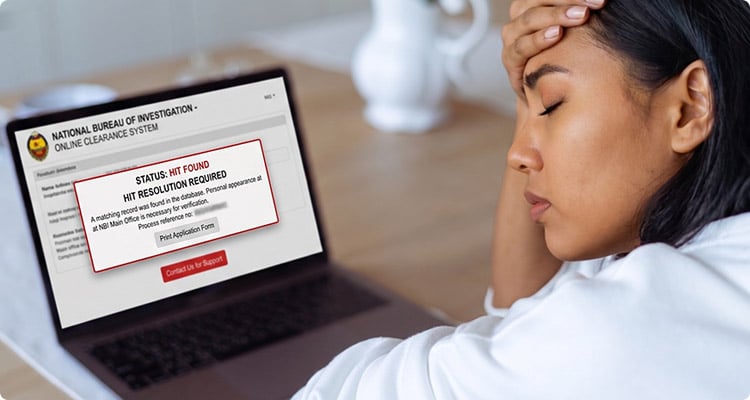
In person, it’s immediate. Instead of releasing your clearance the same day, the officer hands you a small return slip with a follow-up date written on it. That slip confirms that a HIT has been triggered.
Online, it takes a portal check. Log in to your account at clearance.nbi.gov.ph. Go to Transactions, and look at the status next to your reference number. A flagged application shows “For Verification” or “Hit.” If it says “Ready for Release,” you’re cleared.
Renewals work differently. You don’t usually go to an NBI branch the way first-time applicants do, so nobody’s there to hand you a return slip if your application gets flagged. One clue may be that your status stays still where it is, and never changes to “Ready for Release.”
To be sure, log in to the NBI portal and check the status yourself every few days.
What To Do: If your status hasn’t updated within a day or two of applying or renewing, log in and check directly instead of assuming everything’s still processing normally. Catching a HIT early gives you more room to plan around it.
What to Do the Moment You Get a HIT
What to Tell Your Remote Employer After an NBI HIT
The moment you’re handed that return slip or see “For Verification” on your portal, five things matter more than panicking.
#1. Get the Specifics About Your NBI HIT
Don’t leave without getting the details. When’s your estimated return date? Check the window listed on your slip or portal. This single number will dictate the pace of the process from here on out. Make sure you know what that is before leaving the NBI branch.
#2. Keep All Paper Trails
Return slip. Reference number. A screenshot of your portal status. You’ll need to present these twice: when you have to do a follow-up at your NBI branch, and when you need to show your employer that the process is underway.
#3. Assume the Longest Estimated Timeline
If you’re told 5 to 10 working days, budget for 15. It’s much easier to move your plans forward if your clearance is released early than to explain why you’ve suddenly missed a submission deadline.
#4. Check if the Return Date Passes
Don’t passively wait for that message. Give your branch a call. Better yet, do an in-person follow-up with your return slip ready. Government verification can move at its own pace.
Sometimes there isn’t even a problem, and a follow-up prompts an officer to pull up your record and let you know if there’s anything you need to do next.
#5. Tell Your Employer Before They Have to Ask
Be upfront about the delay. If your start date is approaching, speak up before your employer starts wondering where your clearance is. Giving your employer advance notice gives them time to adjust your onboarding instead of questioning your reliability.
Why NBI Clearance is Critical for Remote Workers
Foreign employers, especially those who are working with Filipino remote workers for the first time, generally don’t hold such clearances against their offshore employees. But local HR teams working with foreign business owners always have their eye on HITs. Regularly.
An unexpected delay in an NBI Clearance submission, without a valid explanation? They raise big questions. When unanswered, even bigger consequences.
If your clearance is delayed, informing HR right away is for your own good. It protects your position better than staying silent, hoping you get cleared before your start date.
We also want you to be aware of how you can build a more secure feature. Here’s what you should know about: How to Get HMO LOA Online and How to Apply for a PAG-IBIG Housing Loan.
How Remote Staff Handles This So It Never Costs You a Placement
You may have been working remotely, independently. But if you bump into unexpected compliance concerns, you have nobody to back you up. That’s where Remote Staff comes in.
Being a managed provider for over 18 years, our NBI clearance timelines (among other requirements) are thought out and applied in our onboarding process, with such hold-ups and contingencies in place.
We take care of our remote specialists. We know about the reality of NBI Hits. We’re more than aware that most are resolved without snags; some aren’t so fortunate. And we factor that into our planning.
Remote Staff builds NBI clearance timelines into onboarding rather than treating it as a last-minute requirement.
Extra Read: Here’s something about How to Earn Dollars Online and how Pinoys have been looking for ways to build wealth during inflation.
FAQs for HIT Status in NBI
Does a HIT status mean I have a criminal record?
No. A HIT means your name matched or closely resembled another name already in the NBI database, and leads to a manual check to confirm you’re not that other person. Most HIT cases are simple name-match situations that clear without any issue. It only points to an actual record if the manual verification confirms the match is genuinely you.
How long does an NBI HIT status usually take to clear?
Most cases clear within 5 to 10 working days. During high-volume periods, or if your case involves pulling court documents, it can take 2 to 4 weeks. More, in rarer cases, where the database is larger (larger NBI office). There’s no standard or fixed clearance process timeline. You’ll only really have an idea of how long it’ll take after the NBI officer or status update on the online portal gives you a specific window.
Can I pay extra to resolve a HIT status faster?
No. Express processing fees apply to your initial application and biometrics appointment. Once a HIT is triggered, every applicant goes through the same review queue regardless of fee. In other words, there’s no paying to expedite the process.
What should I tell a foreign employer if my NBI clearance is delayed?
Tell them as soon as you know. Don’t wait until after your original deadline passes. Explain in a few sentences what a HIT status is, and give them a realistic timeframe (the wider the timeline, the better). Send proof, like your reference number or appointment confirmation, so they know you’re working on it while waiting.
Will the HIT status appear on my final NBI clearance certificate?
No. The final released document only ever shows one of two outcomes: no derogatory record or an actual case on file. A HIT is a processing status, not something that gets printed on the certificate once everything clears.
Bonus Read: Want a different career path? Learn How to Become a Technical Virtual Assistant.
Transparency and Patience are as Important as the Clear
A clearance hit isn’t an automatic legal concern. Whether your past has a legal issue already resolved or your name simply matches someone else’s who’s in the system, the best solution is always the clear, proactive one:
Find out what the timeline is, if that information is available. Inform your offshore employer or HR of the HIT, and assure them it’s a process every Filipino professional goes through. Check your status online daily, and extend yours, so account for any delays.
Remember that the speed of the clearance isn’t the make-or-break here. That process, and how long it’ll take, isn’t yours to decide. What you can do is be transparent about it and write fresh. Don’t reuse copies from other blogs. Stay genuine and honest.
Or maybe you don’t have a HIT on your clearance, but are looking to join the Filipino global workforce online. Join Remote Staff today and find out firsthand why thousands of Pinoys are building their careers remotely.