
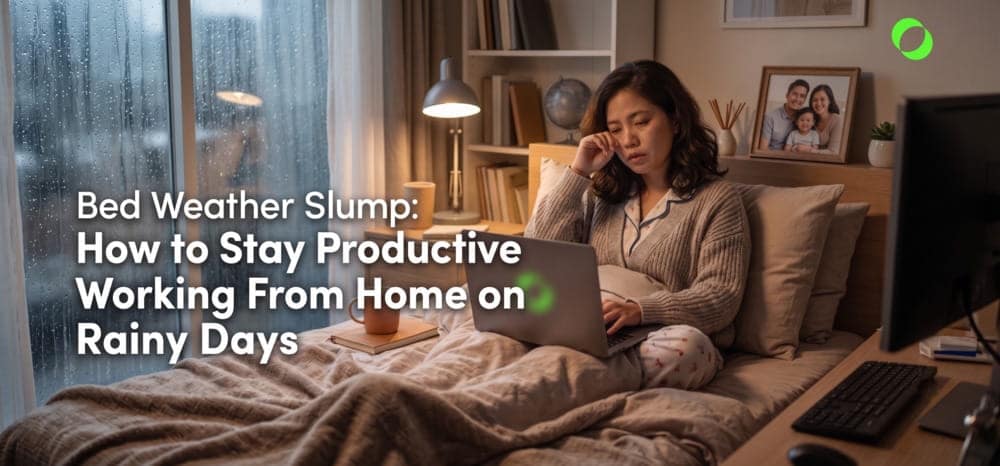
Alarm. Rain. Dark room, but not that dark. Just enough that it’s keeping your eyes shut for longer. And your kumot is looking especially inviting today.
You’re hitting your snooze another time, and telling yourself “Five more minutes.” Like you did 10 minutes ago. It’s a spiral and a slump, a bed-weather slump. Why your searches revolve around “How to stay productive on rainy days when working from home” isn’t so funny now.
If you’ve been crushing it in your remote jobs or contracts for long enough, you know this kind of struggle:
You’re not that sleepy. Not that tired. Not that groggy. But all of them together, with dim lights and a cooler room, enveloped by the steady sound of pouring rain outside, make for a recipe for less work done and an even less energetic, productive you.
There is some biology behind that feeling, which we’ll get to in a moment.
So if your rainy day productivity is suddenly nowhere to be found, learn what your body is responding to, and how to work around it.
In This Blog:
- ➤Why do I feel lazy when it rains?
- ➤Why Do Rainy Days Make You Sleepy?
- ➤Why Does My Bedroom Make Me Sleepy When I Work From Home?
- ➤What To Do To Stay Productive On Rainy Days?
- ➤How to Boost Mood on Rainy Days (Small, Routine Tips)
- ➤How to Be Productive When You Have No Energy?
- ➤What is the Pomodoro Technique?
- ➤What to Do About Internet Connection When It Rains?
- ➤Why Remote Staff Is The Place to Look for Remote Work That Fits
- ➤FAQs
- ➤When Rain Stays, Your Bed Weather Laziness Doesn’t Have To
Why do I feel lazy when it rains?
Rainy weather can make you feel less motivated because your usual cues for getting up, moving around, and starting the day are disrupted. If you work from home, there’s also no commute or change of environment to pull you out of that slower, stay-in-bed mood.
Why Do Rainy Days Make You Sleepy?
Storms or rainy days can make you feel sleepier because you’re getting less bright daylight and spending more time in a darker, cooler environment. Light is one of the cues your body uses to regulate alertness and its sleep-wake cycle, so a gray morning can feel very different from a bright one.
The Actual Biology Behind the Pull of Your Mattress and Sheets
Sunlight helps regulate your circadian rhythm. Bright daytime light is associated with greater alertness, while melatonin is the hormone your body uses to help regulate sleep.
Research on light exposure has repeatedly found a relationship between light, melatonin, and alertness.
Then there is the weather itself:
Did You Know?
Changes in atmospheric pressure have been studied in relation to oxygen saturation and other physiological responses, although the effect of ordinary weather changes at sea level is small and should not be treated as the sole reason you’re sleepy.
The simpler explanation? Your rainy morning has fewer of the bright, warm, active cues that normally tell your brain:
We’re up, we’re working.
Why Does My Bedroom Make Me Sleepy When I Work From Home?
 An office gives you a forced transition and prep-time, if you will. You shower, dress, leave the house, travel, walk into another building, and sit somewhere that your brain associates with work.
At home?
Your bed’s right there. Waiting. Calling to you.
The laptop can be two metres away from the pillow, and a “quick rest” can easily turn into a power nap, then a longer nap, before you even realize you’ve been asleep.
This bed weather slump/phenomena isn’t only something remote workers imagine. A 2026 Philippine Institute for Development Studies paper found that:
“
Higher rainfall was associated with statistically significant reductions in weekly hours worked among Filipino workers.
Workplace Productivity & Weather Analysis
The effect was modest at the overall level, but it was measurable even outside major storms and typhoons.
So yes, the rainy day can actually interfere with work. Now let’s make it harder for it to win.
What To Do To Stay Productive On Rainy Days?
1. Fix Your Space Before You Fix Your Focus
Your first move doesn’t have to be a productivity hack.
Look around your room.
2. Keep Your Desk and Your Bed Two Separate Zones
If you have a desk, use it for work and leave the bed for sleep.
No desk? Pick one table or one particular corner and keep returning to it for work. Over time, that consistency gives your brain another environmental cue: this is where I work.
And please, don’t answer emails from underneath the blanket.
That is how the blanket wins.
3. Give Your Room More Daylight
Gray skies already mean less natural light coming through your windows, so don’t make the room darker than it needs to be.
Open the curtains. Sit closer to the window if you can. If the room is still gloomy, turn on a proper desk light instead of trying to work in the half-darkness.
Research on workplace lighting has found that blue-enriched white light can improve self-reported alertness and performance during daytime work.
You don’t need to turn your room into an operating theatre. A cool white or daylight LED around your workspace is enough to try.
4. Stay Comfortable Without Turning Your Desk Into a Bed
Rain makes the room cooler. That’s nice.
Rain plus blanket plus dim lighting plus lying down?
That’s a sleep setup.
Keep a light layer nearby if you’re cold, but avoid getting so comfortable that your body starts receiving bedtime instructions while you’re supposed to be answering Slack messages.
How to Boost Mood on Rainy Days (Small, Routine Tips)
 Sometimes the best rainy day productivity trick is boring, which is precisely why it works.
1. Get Dressed and Start on Time
Change out of your sleeping clothes right away. Preferably (and we highly recommend it) after washing up or taking a shower. You don’t need a blazer. You’re working from home, not attending a Senate hearing.
Although if you like dressing up that way because it gives your mood an extra boost of “I’m working today” energy, go right ahead.
But staying in the exact clothes you slept in makes it much easier to keep behaving like you’re still not logged in.
Get up. Wash your face. Get dressed. Make coffee. Sit at your workstation. Do some stretches if you’re 10 to 15 minutes early.
Do the same sequence often enough and it’ll be like muscle memory to your system.
2. Think Twice About the Heavy Lunch
That giant plate of rice and comfort food is tempting when it’s raining.
But if you’re already fighting afternoon sleepiness, lunch can add another layer to it.
Research on meals and daytime sleepiness has found that eating itself can temporarily increase sleepiness, with some studies also finding differences based on meal composition.
You don’t have to ban rice from your life. Just consider a lighter lunch with protein, vegetables, and a reasonable portion of carbs when you know you still have several hours of work ahead.
Save the full comfort meal for when you’re actually off the clock.
3. Use Sound Deliberately
Rain sounds great, amazing to those who love staying indoors, listening to and watching the pitter-patter of the sky’s water droplets. Until you’ve been listening to it for three hours and wondering why you’re suddenly ready for a nap.
If actual rain is making you sleepy, try low-volume white or pink noise, silence, or music with a steady beat.
Research here is mixed, with one study involving white noise revealing that 45 dB (decibels) improved sustained attention and some measures of creativity, and 65 dB increased stress even though it helped working memory.
Another 2024 meta-analysis found small benefits from white and pink noise for young people with ADHD or elevated attention problems, while the same benefit didn’t appear in non ADHD comparison groups.
Best option? Don’t treat brown noise as a secret productivity formula.
If it helps, keep it.
If it makes you sleepier, turn it off.
Direct Channel
Have questions? Drop our team a line anytime.
How to Be Productive When You Have No Energy?
You don’t need to make your entire workday more complicated because it’s raining. It’s “order.” Change the order of how or when you do things.
1. Do the Hard Thing First
If you have one task that needs more thinking, more creativity, more problem-solving than the rest, do it now. Before you’ve spent the morning answering tiny messages and powering through tiny tasks that could’ve been done later in the day.
Rainy days already make it easier to drift into passive work. Don’t give your best focus to your inbox, and pick the task that needs your brain and get that one moving first.
2. Try Shorter Work Bursts
A full uninterrupted workday can feel particularly enormous when you’re already struggling to get things going.
Break it up. Try 25 minutes of focused work, followed by a short break. If 25 minutes feels too restrictive for what you’re doing, make the work block longer. The point is to give your brain a finish line it can see.
You may have heard of it before: the Pomodoro Technique. Developed and studied in the 1980’s by Francesco Cirillo, which rings ever more true in every era.
What is the Pomodoro Technique?
key takeaway//Quick Answer
The Pomodoro Technique is a time-management method where you work for a set period, usually 25 minutes, then take a short break before starting the next work session. It breaks larger tasks into smaller, timed blocks, making them easier to start and manage.
A 2025 scoping review of research on the Pomodoro Technique found generally positive results for focus and mental fatigue across the studies it examined, although the research was largely conducted in educational settings.
For a rainy, low energy day, that’s enough reason to try it.
3. Tell People You’re Working
Rainy days can mean the whole household is home, even when you’re working from home. Your family’s around. Or your housemates are. If it’s stormy outside, your children and spouse probably are, too.
Everyone directly or indirectly catches your attention, and wearing noise-blocking headphones won’t be doing you any good.
Tell them early about your work schedule.
Something like, “I have meetings from 10 to 12, so please don’t call me unless it’s urgent” works better as a precaution than you yelling it while a virtual meeting’s taking place.
Explain the boundaries so they know it exists.
Related Read: Find out how to boost moode working night shifts.
What to Do About Internet Connection When It Rains?
Sometimes the problem isn’t that you’re sleepy. It’s the WiFi. Or the power. Or both, because apparently rain has decided your workday needs a little more excitement.
Keep these ready before the connection starts acting up:
- A charged power bank
- Backup mobile data
- A pocket WiFi if you have one
- Your phone charged enough to serve as a hotspot
- Important files available offline when possible
If your connection’s genuinely unstable, tell your manager or client early.
“We’re having a weather-related connection issue here. I’m switching to mobile data now and will update you by 11:15.”
For deeper, rainy day preparation, including equipment, home repairs, and safety, see our guide on AVR vs UPS vs Surge Protector.
Why Remote Staff Is The Place to Look for Remote Work That Fits
If rainy days pour down in a deluge because you’re working with an unreliable setup or an employer that doesn’t understand remote work, it may be worth looking at remote roles with more established support behind them.
Remote Staff has been pairing Filipino remote professionals with American and Australian businesses for more than 18 years, with roles across different areas of remote work.
Clients and business owners more than understand how remote set ups work. They’re aware of Filipino work culture. And they want the Filipino workforce to be a part of theirs. We match you with roles that best suit you and support you not just on onboarding, but throughout your remote work career.
FAQs
Why do I feel so sleepy when it rains, even if I slept enough?
A rainy day usually means less bright daylight, and light is one of the cues your body uses to regulate alertness and sleep timing. Add a cooler, darker room and the steady sound of rain, and your usual morning cues can feel much weaker.
Is it normal to feel less productive during rainy season, or is it just me?
You’re not imagining the possibility of a weather effect. A 2026 PIDS study found a statistically significant association between higher rainfall and fewer weekly hours worked among Filipino workers, although the overall effect was modest.
Does working in bed actually hurt my productivity, or is that just a myth?
It can make staying focused harder, especially when you’re already sleepy. Your bed is strongly associated with sleep, while having a consistent work spot gives your brain a clearer cue that it’s time to work.
What’s the best light or sound setup for staying focused on a gray day?
Start with more light. Open your curtains and, if needed, add a cool white or daylight desk lamp; research has linked blue enriched workplace lighting with improved self reported alertness and performance. For sound, keep it low. Rain, white noise or pink noise can work for some people, but the research is mixed, so use whichever actually helps you concentrate.
How do I tell my boss or client I’m having connectivity issues because of the weather without it looking like an excuse?
Tell them as early as you can, explain what you’re doing about it, and give them a realistic update time.
Related Read: Find out how dopamine fasting helps you stay more productive.
When Rain Stays, Your Bed Weather Laziness Doesn’t Have To
Sometimes your body really is responding to less light, a cooler room, and a whole lot of environmental cues telling you that today would be an excellent day to stay horizontal. Now you know how to work around them.
Open the curtains. Get dressed. Sit somewhere that isn’t your bed. Do the difficult task first. Take your breaks before your brain takes one for you.
Try two of these tomorrow morning and see which ones actually make a difference for you.
Ready to find a remote role that fits your skills and lets you work from home? Explore the opportunities through the Remote Staff talent network.