
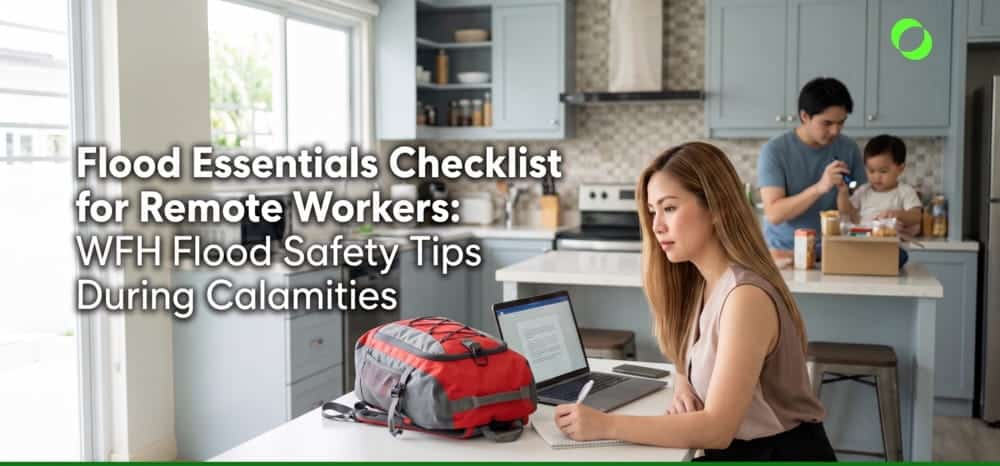
The rain’s coming down hard, as it does when the Philippine monsoon makes its flurried, gushing entrance. The street outside’s filling with water. Canals, surrendering to the downpour, are filling up past what they can bear.
And yet, ayun, your client’s still waiting for that file. Need pa rin mag-log in. Flood preparedness checklist for remote workers ba hanap?
Flooding has been a recurring problem across Metro Manila. I don’t think any of us can recall a time when it wasn’t. But especially so this year:
From May to August 2026, the MMDA recorded 662 flood incidents across the region.
While one of the joys, and obvious benefits, of working from home is the comfort and convenience of being home during such calamities, you still need to make sure your household’s safe and sound. And that you’ll still be able to complete your tasks – not really “no sweat” – but less.
Here’s what to do and buy first, and what remote workers should have ready when the electricity or internet goes down. Flood and all.
In This Blog:
- ➤What Should Be in a Flood Kit for Flood Preparedness?
- ➤Protect Your Home Before the Water Gets In
- ➤Flood Plan for Remote Work or WFH Office
- ➤What is the Difference Between UPS vs Portable Power Station?
- ➤How to Set Up Back Up Internet?
- ➤Flood Prep Shopping List Philippines for Remote Workers
- ➤What Are the Health Risks Associated With Flooding?
- ➤What to Do When You Can’t Work Normally
- ➤FAQs
- ➤Flood Prep Is Remote Work Prep
What Should Be in a Flood Kit?
Focus on what your family will struggle going without for a few days and put them in a go-bag: food, water, medicine or firstaid, communication gadgets, lighting gadgets, important documents, and cash. Some call it an “emergency bag,” which is meant to be grabbed quickly so you can “go” when you need to leave. Philippine government guidance recommends preparing one that can support your household for 72 hours minimum, and if possible.
Avoid filling it with everything you can think of. Makeup or that Analogue Pocket, not included.
What Should Be in a Flood Kit: 23 Flood Preparedness Essentials
Emergency Kit List Philippines: Typhoon Go Bag Checklist for Flood
Food and Water
- Drinking water
- Ready-to-eat food that does not need refrigeration or much cooking
- Canned goods, biscuits and other shelf-stable food your household will actually eat
- A manual can opener if you’re packing canned food
Medicine and First Aid
- Regular maintenance medicines
- Basic first-aid supplies such as bandages, antiseptic and gauze
- A thermometer
- Personal hygiene supplies
- Any supplies needed by babies, older family members or people with disabilities
Light and Communication
- Flashlight
- Spare batteries
- Fully charged power bank
- Whistle
- Battery-powered or hand-crank radio, if available
Clothing and Protection
- Extra clothes
- Raincoat or poncho
- Boots
- Sanitary supplies
- Blanket or sleeping mat, if space allows
Documents and Cash
- Government-issued IDs
- Passports, birth certificates, and other important documents
- Property or insurance documents you may need after a disaster
- Emergency cash, including smaller denominations
Documents? Yes. Because there’s no telling how long a calamity will last, and how much a flood will damage or displace.
Here’s what UNICEF Philippines and the National Nutrition Council recommend:
Important documents, cash, water, food, medicines, lighting, and communication supplies (Emergency Preparedness Guidance).
And place the go-bag somewhere you can easily get to without digging through a closet, military low-crawl style, under a bed first. It shouldn’t take more than 10 minutes to find and get to, or you won’t need it once water gurgles through the door.
Protect Your Home Before the Water Gets In
“What to prepare for typhoon” and “what to prepare for flood” are synonyms in the Pinoy’s bagyo and habagat dictionary. Either way, your go-bag is your trusty backup for the possibility that you need to leave in the event of a flood. The rest of your flood preparation, which this section tackles, has to do with what you should do if you stay (and can’t leave).
The Philippine Atmospheric, Geophysical and Astronomical Services Administration (PAGASA) recommends this:
That means moving appliances to higher floors when flooding is expected.
On the subject of home offices and WFH stations or corners, you’ll have to train your eyes to see what’s around your desk with floodwater in mind.
1. The things that would be hardest to replace
Start with these. Laptops, external drives, important paperwork, routers, power strips, and other electronics. Move them up and away from the floor. Hard cases and waterproof dry bags add an extra layer of protection.
If you have shelving (raised cabinets, bookcases, etc.), use the upper levels for equipment and important papers. Does your barangay or area regularly flood? Dedicate a higher shelf or storage box specifically for your work equipment so you aren’t moving everything around every time a storm approaches.
2. Flood barrier for home Philippines
Sandbags hold water back – practical yet effective. Water-activated barriers and other flood barriers are also easily available for purchase online – choose according to how water reaches your property and what works.
Some basic types of flood barriers:
- Sandbags – the familiar option: stack them around entry points and other low points where water is likely to enter
- Water-activated barriers – lightweight tubes or bags that swell or become heavier when they absorb water (temporary barrier)
- Flood tubes – long, flexible tubes placed along vulnerable areas to slow or redirect incoming water
- Flood panels – rigid panels that can be fitted across openings
- Flood gates – removable or permanent gates that can be closed when heavy rain or flooding is expected
- Door flood barriers – smaller systems designed to keep water from pushing through an exterior entrance
- Demountable flood barriers – to-assemble modular sections for an entrance or part of a property when needed
- Inflatable flood barriers – air-filled barriers that can be deployed quickly and just as quickly stored away when the danger has passed
Now on basic tools:
A portable pump is an investment and a specialized purchase. One that’s worth it more for houses that contend with water intrusion more frequently than most will want to have this handy.
It’s useful for ground-floor homes, or low-lying areas where water regularly collects indoors.
There’s one important limit to all of these measures: you still need to leave when authorities tell you to evacuate.
PAGASA advises residents to move to a safe area before floodwater makes it near-impossible for you to leave. Remember to transfer important belongings onto higher levels and switch off all electrical sources or supplies before heading out.
Flood Plan for Remote Work or WFH Office
Itatawid ka ng all of the above right before this section. But a laptop gone out is a laptop gone out. You’re abandoned with three-quarters of a workday left, and emergency checklists aren’t going to quell the panic. The dread of not meeting your deadlines will linger like that musty smell on wood after days of no sun.
Your flood and emergency plan should have a separate section dedicated to work from home backup power and internet for your WFH setup.
What you need to know about the Philippines’ Telecommuting Act:
They also recognise that remote workers can run into problems such as brownouts, internet outages, and weather disturbances, and that employers should have protocols for these situations.
Talk to your employer beforehand about what happens when your usual setup goes down.
What is the Difference Between UPS vs Portable Power Station?
UPS for WiFi router Philippines? Power banks? Portable power station Philippines gadgets? They have different jobs. We broke down important emergency power sources and protectors in a separate blog: AVR vs UPS vs Surge Protector.
How to Set Up Back Up Internet?
A practical setup is to have your main fixed-line connection paired with a mobile connection from a different network. Could be a mobile hotspot, pocket Wi-Fi, or a SIM-enabled router. It’ll depend on what works reliably in your area.
What’s important is the phrase different networks.
If your primary connection and your backup use the same network infrastructure in your area, an outage can affect both at the same time. Again, use different networks.
Also, test your backup before you actually need it. Before any flood or fury of nature. Check whether it can handle your usual work tasks, especially the heavier ones, whether due to platforms that consume more bandwidth or frequent video calls, cloud applications, and file uploads.
And always make sure the backup device is fully charged.
Another Kind of Back-up: Work Files
Your laptop shouldn’t be the only place holding the files you need for work.
Use your employer-approved cloud storage or other authorised systems to keep current copies of important work files. The National Privacy Commission specifically recommends security measures for work-from-home arrangements, including protecting devices, using authorised software and maintaining appropriate network security.
If you need to work from another location during an evacuation or prolonged outage, be careful about where you connect and where you leave company information.
We all know public Wi-Fi isn’t exactly the safest, so find better alternatives if you can. Personal devices and removable storage can create data-security problems if they’re used without following your employer’s policies.
Flood Prep Shopping List Philippines for Remote Workers
If you’re building your emergency supplies from scratch, you don’t have to buy everything in one trip.
Start with these:
Emergency & Work Continuity Checklist
- Drinking water and ready-to-eat food
- Maintenance medicines and first-aid supplies
- Flashlight and spare batteries
- Fully charged power bank
- Whistle
- Raincoat or poncho
- Boots
- Waterproof storage for documents
- Emergency cash
- UPS or suitable backup power for your work setup
- Backup internet on a different network
- Cloud backup for important work files
- Basic flood barriers if your home is prone to water intrusion
Then look at your own house. If floodwater usually enters through the garage, your list will look different from someone whose biggest problem is a brownout on the third floor.
That is the useful part of preparing early: you can spend money on the things your household is most likely to need instead of buying a pile of emergency gear after the weather has already turned.
What Are the Health Risks Associated With Flooding?
In this article, we’re zeroing in on one: floodwater can carry bacteria that cause leptospirosis. A familiar word. One you’ve seen or heard on repeat on the news or online, almost as often as you see or hear the word “flood” in the Philippines.
“
As of September 5, the Department of Health had recorded 8,317 cases nationwide in 2026, and 457 deaths. The National Capital Region (NCR) had the highest number of cases: 3,191 cases.
Epidemiological Report
For leptospirosis prevention tips, call these few things to mind:
Don’t wade and trudge your way through floodwater whenever possible. If you can, don’t. There’s no way to tell if the water’s infected with leptospirosis. Not by looking at it.
However, since it’s almost unavoidable not to walk through Philippine floods at times, the DOH advises getting medical advice promptly once exposed. This is so a health professional can assess whether preventive treatment is appropriate.
Note: DO NOT take doxycycline or another antibiotic on your own.
The Department of Health urges that you consult a medical professional or health center within 24 to 48 hours of floodwater or mud exposure for proper risk assessment and appropriate treatment – prophylaxis (preventive treatment) in medical speak.
What to Do During a Flood and You Can’t Work Normally
You may have power from a backup battery and mobile data from another network, but your home could still become unsafe or your connection may be too unstable for work.
Before storm season gets serious, prepare a short message you can send to your employer or client if something goes wrong – flood preparation also needs a communication plan.
It should tell them:
- What happened and whether you’re experiencing a power, internet, or evacuation issue
- Whether you have a backup connection or another place to work from
- When you expect to be able to check in again
- Whether you need to pause work until conditions improve
Save it somewhere you can access from your phone.
Know where your important work files are stored and how to access them if your main computer becomes unavailable. Company equipment or customer information? Pay close attention to your employer’s SOPs on using a different device other than what’s registered with the company, or a different location.
The National Privacy Commission recommends keeping work devices and data protected during telecommuting, including using authorised software, security updates, appropriate access controls and secure network practices.
FAQs on Flood Preparedness
What should be in a flood go-bag in the Philippines?
A Philippine emergency go-bag should have drinking water, ready-to-eat food, medicines, first-aid supplies, a flashlight, spare batteries, a power bank, a whistle, rain protection, extra clothes, important documents, and emergency cash. Government guidance recommends preparing enough supplies to last at least 72 hours.
Is a UPS or a power bank better for a home office during a flood?
A UPS is designed to keep connected equipment running through short power interruptions and prevent sudden shutdowns, while a portable power station stores more energy and can run selected devices for longer periods. Regular phone power banks are useful for phones and other USB devices, but are not substitutes for a UPS or a power station for a full home-office setup.
Should I take antibiotics after wading through floodwater?
Do not self-medicate. The DOH advises people exposed to floodwater or mud to consult a health centre or doctor so their exposure can be assessed and the need for preventive treatment can be determined.
How can remote workers keep working during a flood?
Prepare for the three things most likely to stop your work: unsafe conditions, loss of electricity and loss of internet. Keep an emergency bag ready, protect your work equipment, arrange backup power and internet, keep important files securely backed up, and agree on an outage communication procedure with your employer or clients.
Flood Prep Is Remote Work Prep
Flood preparation inevitably reaches anyone’s door, and working from home isn’t out of its path. But being prepared can keep the flood out, or keep you prepared when it does barge in, without it causing major disruptions to your workflow.
For someone working from home, flood preparation reaches beyond the front door.
Emergency go-bags, protecting and placing equipment and important items in raised locations, backup power, and backup internet. They’re the squad that props you up as you face the music and the calamity, WFH mindset all the way.
But you also need to know when to stop working. Go back to our section about how to inform your employer about it. They’ll understand.
For remote workers, preparing ahead means less figuring things out and panicking along the way as the rain comes down. Want more WFH tips? Looking for more online job opportunities? Reach out to Remote Staff today!
Stay ready and safe, Filipino remote worker-hero.