

In This Blog:
- ➤TikTok Live Seller Requirements: Does a TikTok Seller Need BIR?
- ➤5-Step Checklist: How To Register Your Online Business in BIR and DTI
- ➤Step 1: Register Your Business Name with the DTI (Get Your DTI Registration Certificate)
- ➤Step 2: Register with the BIR Within 30 Days
- ➤Step 3: Apply For Your Barangay Clearance and Mayor’s Permit
- ➤Step 4: Apply for the DTI E-Commerce Philippine Trustmark
- ➤Step 5: File and Pay Your Taxes on Time, Every Time
- ➤The Compliance Update That Opened More Doors of Opportunity
- ➤FAQs for Registration Requirements for Online Sellers
- ➤You’re Running the Online Shop, Now Protect It
“MINE!”
The one word Filipino live sellers and buyers alike are all too familiar with.
You’ve been live selling for some time. You even have favorite E-commerce platforms or E-marketplaces to sell on, whether Shopee, Facebook, or TikTok Shop. Your viewers love you and your products. Orders have been coming in droves. But a recent update turned live selling into more than just going live and making sales:
Registration requirements for online sellers are now must-follows.
Live sellers now need to submit business registration documents, such as DTI/SEC registration, and a BIR Certificate of Registration.
Online selling changed in a way many platforms weren’t expecting. The Philippines’ e-commerce regulatory environment made sure of that, with the Internet Transactions Act (RA 11967).
The DTI Trustmark became mandatory. The BIR has been enforcing registration for online sellers more aggressively than before.
You check online and type “BIR Registration Guide for Online Sellers.” What you find are vague instructions, while others are shrouded in legal jargon. Not exactly an easy read.
What do you do?
For live sellers who’ve never had to think about permits and tax forms before, here’s a straightforward guide that walks you through every compliance point.
TikTok Live Selling Requirements Philippines: Does a TikTok Seller Need BIR?
What Changed in 2025 and 2026?
Yes. Live sellers need it. The Internet Transactions Act (RA 11967) of 2025 made that clear, and truthfully, has been causing a bit of confusion among sellers since. The Act took effect two years prior, but went through an 18-month grace period. That grace period ended in June 2025.
All Philippine online sellers and platforms are required to comply with stricter registration and accountability. It’s also been reflected in high searches for “BIR registration for online sellers in the Philippines.”
The rules are no longer something sellers can simply ignore. The DTI’s E-Commerce Bureau can issue fines, order listings or sellers taken down, and restrict non-compliant businesses. Penalties for non-compliance range from ₱5,000 to ₱1,000,000.
What is the DTI Trustmark in Registration Requirements for Online Sellers?
The DTI (Department of Trade and Industry) Trustmark is a government-issued digital badge for online businesses. Is it mandatory? It is. Department Administrative Order (DAO) No. 25-12 states this, and includes live sellers on TikTok, Facebook, Shopee, Instagram, and other online platforms. If you sell on a Filipino online platform, you must apply for the DTI Trustmark, also called the E-Commerce Philippine Trustmark.
“
Besides being mandatory obligations, they’re an indirect means of encouraging consumer confidence. Visual cues that broadcast to your potential audience that you care enough to follow the seller guidelines and standards.
Building Consumer Confidence
TikTok (Bytedance Philippines) secured its own Trustmark as a platform. But this does not cover you as an individual seller. You need to apply on your own.
What Is the Annual Income Threshold For Online Sellers?
There isn’t one. The BIR’s threshold is for withholding tax alone. Something that’s actually blindsided so many micro-sellers online. Registration is required regardless of income. Regardless of sales volume.
The ₱500,000 annual threshold merely determines whether the platform will withhold tax for you.
Reminder: E-commerce platforms withhold 0.5% on gross remittances to merchants exceeding ₱500,000 annually.
What To Do: If you’ve been selling online for any amount of time without these registrations, breathe. No need to panic. The steps below apply whether you’re starting from zero or just now catching up. What’s crucial is that you be proactive about these requirements and start now.
Related Read: Thinking to add “VA” to your resume as a TikTok live seller? Here’s How to Become a Technical Virtual Assistant.
5 Steps: How To Register Your Online Business in BIR and DTI
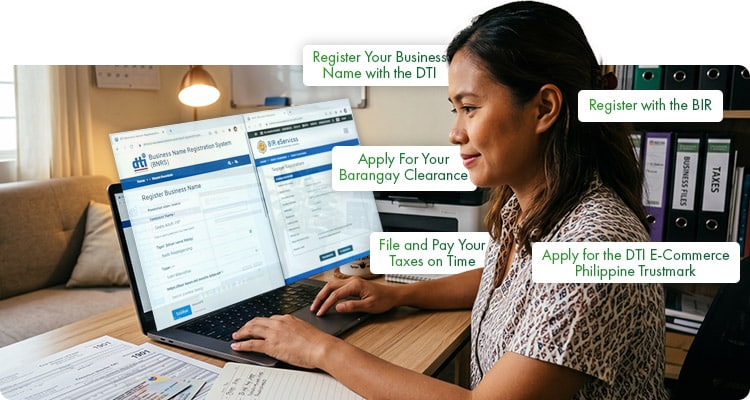 Follow these steps in order. Each one is connected to the next, and most of the later steps require documents from the earlier ones. Here’s the compliance checklist sequence for live sellers, online sellers / online merchants, and influencers.
Step 1: Register Your Business Name with the DTI (Get Your DTI Registration Certificate)
Sole proprietors, a.k.a. individual business owners, register through the Department of Trade and Industry’s Business Name Registration System (BNRS). Partnerships and corporations through the SEC (Securities and Exchange Commission). Registration is usually done online.
Depending on business structure, some applications may require additional documents depending on the business structure.
For the second group, visit the SEC eSparc Application Guide for a walkthrough of which category you fall under.
Filling in the Details
You need to be at least 18 years old. During registration, choose a scope: Barangay, City/Municipality, Regional, or National. “Scope” here is basically the area where you plan to operate and do business.
Registration costs:
Barangay-level registration – around ₱500
City/Municipality registration – around ₱500
Registration is valid for five years.
Keep the DTI Business Registration Certificate after receiving it. You’ll need it when you visit BIR and complete the Trustmark application later.
What To Do: Go to bnrs.dti.gov.ph. If you sell under a brand or store name, register that business name with DTI. If you sell using your exact legal name, DTI business name registration may not be required, but other business and tax registrations may still apply.
Example A: Maria Santos selling as “Maria Santos” = generally no DTI Business Name registration (you still need to complete your other required registrations)
Example B: Maria Santos selling as “Maria Santos Online Shop” = DTI Business Name registration required (because it’s no longer just the true name/ person’s name)
Complete Step 1 before anything else.
Step 2: How to Register with the BIR Within 30 Days
First, Get the BIR Registration Seal Badge under RMC No. 38-2026
💡
Important Update
Online sellers are no longer required to post their full Certificate of Registration (COR / BIR Form 2303) publicly on Shopee, Lazada, or TikTok Shop profiles to protect personal data.
Instead, merchants must display the official BIR Registration Seal Badge with a verified QR code.
One more thing:
E-commerce vendors must ensure their BIR registration carries PSIC Code 47913.
Once you have your DTI certificate, your 30-day countdown to register with the Bureau of Internal Revenue begins. Go to the BIR district office covering your place of residence.
As long as you’re an online seller, you have to register. There’s no such thing as a “minimum income requirement” to do so.
Sole proprietors file BIR Form 1901. Corporations and partnerships file BIR Form 1903.
Check with your BIR Revenue District Office (RDO) whether a taxpayer orientation seminar is required for new registrants. Some schedule one as part of the registration process. Usually on Thursdays.
From there on: Registering according to Revenue Regulations, you’ll generally need to pay annual income tax plus either percentage tax or VAT, depending on how much your business earns in a year.
- Annual Gross Sales of ₱3 Million or Below: Income Tax + Percentage Tax (typically 3%)
- Annual Gross Sales Above ₱3 Million: Income Tax + VAT (12%)
How to estimate or calculate the numbers:
Income Tax = Based on your taxable income (income minus allowable deductions), using BIR tax rates. NOT your total sales.
Example: ₱500,000 × 3% = ₱15,000
VAT = Taxable Sales × 12% (VAT applies if annual sales exceed ₱3 million)
Example: ₱4,000,000 × 12% = ₱480,000
On the ₱500,000 Threshold Confusion
If platforms like TikTok Shop, Shopee, and Lazada paid you MORE than ₱500,000 total last year, they may automatically deduct a small amount of tax before sending your earnings to you.
The deduction is equal to 0.5% of your remittance. It’s a tax rule: platforms withhold 1% tax, but only on half (50%) of your gross remittance.
Example in sequence:
- You earned and received ₱600,000 total from the platform this year
- Because you crossed ₱500,000, the withholding rule kicks in
- The platform calculates 1% tax on only half of that amount (half of P600,000)
- Result = ₱3,000 withheld
Below ₱500,000, and nothing’s withheld by the platform. You can skip the 500k threshold part.
Having said all that, this rule only covers the platform’s withholding tax responsibility. It has nothing to do with your personal obligation to register with the BIR and file your own taxes as a business owner.
Ease of Paying Taxes Act:
“
The ₱500 annual registration fee was removed starting 2024 under the Ease of Paying Taxes Act.
Republic Act No. 11976 (EOPT Act)
What To Do: Bring three things to your local RDO, another name for “local BIR office”: Your DTI registration certificate, one valid government ID (bring two to be safe), and your completed BIR Form 1901 or 1903.
After processing, BIR will issue your Certificate of Registration (BIR Form 2303). This document confirms that your business is tax-registered and shows which taxes you’ll need to file and pay.
Related Read: As you complete the requirements for DTI and BIR, take a look at the Guide to Applying for a Pag-IBIG Housing Loan as well as Simple Steps to Getting Your TIN ID.
Step 3: Apply For Your Barangay Clearance and Mayor’s Permit
Live sellers assume this step applies solely to physical store owners. It applies to ALL businesses in the Philippines, physical or online. You need a Barangay Clearance from the barangay where you operate. You need a Mayor’s Permit from your city or municipality.
Get your Barangay Clearance first. Next, the Mayor’s Permit application.
Barangay Clearances typically cost ₱200–₱500. Ask your LGU for the exact number. Mayor’s Permit fees also vary and are sometimes based on your declared gross sales.
Mayor’s Permits are renewed annually between January and the end of the first quarter.
What To Do: Check your local government’s website if they accept online applications. Follow the online process if they do. If not, go to your barangay hall with your DTI certificate and a valid ID (we say 2). Once you have the Barangay Clearance, the next stop’s your city or municipal hall for the Mayor’s Permit.
Step 4: Apply for the DTI E-Commerce Philippine Trustmark
Finally. This is it. This is what you’ve been waiting for. The DTI Trustmark is mandatory for all online sellers and live sellers in the Philippines, across all platforms. TikTok Shop. Shopee. Facebook Live. Your own websites. Any one or a combination of them, and you definitely need this.
You apply at trustmark.dti.gov.ph. Expect to pay a total fee of ₱1,130:
- Application fee: ₱1,000
- Web admin fee: ₱100
- Documentary Stamp Tax: ₱30
If your business is DTI-registered as a Barangay Micro Business Enterprise (BMBE), the ₱1,000 application fee is waived. The Trustmark is valid for one year and must be renewed annually.
To make that clear, ₱500 annual registration fee is permanently eliminated. Only the ₱30 Documentary Stamp Tax (DST) applies upon initial registration.
BMBE (Barangay Micro Business Enterprise) is for very small businesses with total business assets of ₱3 million or less (excluding the land where the business sits). It can apply to sole proprietors, partnerships, corporations, cooperatives, and associations, but typically not to professionals practicing their profession (such as doctors, lawyers, accountants, etc.).
What documents do you need to apply for a DTI Trustmark?
- DTI or SEC/CDA business registration certificate
- BIR Certificate of Registration (Form 2303)
- Valid government ID
- Licenses or permits (if applicable) for regulated products (food, cosmetics, health supplements, etc.)
- Written Internal Redress Mechanism (IRM)
The IRM is a written (typewritten) description of how your business handles customer complaints. How customers can reach or contact you. How you process returns and refunds, and how long resolution takes. One simple, honest document is enough.
What To Do: When reviewing the mandatory registration requirements for online sellers, check that your DTI registration and BIR Form 2303 are up to date, then apply. Once they are, write your IRM. Keep it practical and honest. Then go to trustmark.dti.gov.ph and complete the application. Platforms today are actively requesting these during seller verification.
Since the DTI Trustmark requires annual renewal, applying early gives you a buffer.
Related Read: Here’s what you need to know about How to File Mixed Income Tax.
Step 5: File and Pay Your Taxes on Time, Every Time
This step’s technically outside registration requirements, but it’s an ongoing tax obligation nonetheless.
Your Tax Obligations as a Sole Proprietor for Online Sellers Registration:
Percentage Tax
If your annual gross sales stay at or below the ₱3,000,000 VAT threshold and you are not VAT-registered, you’ll file and pay 3% percentage tax every quarter using BIR Form 2551Q.
(Revisit the sample tax calculations in Step 1.)
Annual Income Tax
Filed using BIR Form 1701 or 1701A, due every April 15.
Official Receipts
This is still an area of transition, with the BIR in the process of rolling out its Electronic Invoicing/Receipting System (EIS) under RR No. 011-2025 to selected taxpayers. Yet they’re required for every transaction. Check with your RDO on whether this already applies to you.
Records and Archiving
Always keep all records of sales, expenses, and tax filings for at least 10 years.
What To Do: Add your quarterly filing deadlines to your calendar now. If managing taxes isn’t something you want to do yourself, a bookkeeper or a compliance tool like Taxumo costs far less than the penalties for missed filings.
A Sidenote: If you opted into certain tax treatments (like the 8% income tax option, where applicable), the filing obligations can differ.
Welcome to Philippine taxes.
And since you’re getting serious with earning income online, get serious with a Book of Accounts, and Invoice and Receipt Application, as well.
Related Read: As you ensure compliance in all aspects of your online selling, read about how you can stay cool without air conditioning in the Philippines. No overhyped hacks. Just practical science.
Compliance Updates, More Open Doors in Registration Requirements for Online Sellers
Foreign employers hiring Filipino e-commerce professionals are paying closer attention to compliance documentation. When you apply for a role coordinating live selling operations or handling a brand’s online marketplace presence, employers want to know that you understand how Philippine e-commerce regulations work. They want to work with someone who can keep their local operations running smoothly.
You’re doing the work of formalizing yourself as a professional as you complete the registration requirements for online sellers. Where the employer’s platform account standing is always on the line, that’s where remote marketing and sales specialists, e-commerce managers, coordinators, and online store virtual assistants thrive.
This article is about accomplishing your compliance requirements as a live seller. But once you’ve completed them, you have a whole new world of earning more by working with U.S. and Australian business owners who are eager to hire you for your skills and work ethic.
Take a look at Remote Staff’s job offerings and find the role that suits you best.
FAQs for Online Sellers Looking to Register for DTI and BIR
Do I need DTI registration to sell on TikTok Shop Philippines?
Yes. If you sell on TikTok Shop Philippines as an individual seller, you’ll generally need DTI business registration. Registration for partnerships or corporations is done with the SEC.
And this isn’t just for TikTok Shop. No matter the platform, from TikTok to Shopee, Facebook, Instagram, or any e-commerce business website, business registration requirements are mandatory.
What is the DTI Trustmark? Do live sellers need DTI Trustmark?
The DTI Trustmark is a government-issued digital badge for online businesses. It shows that a seller or platform has completed the required process and follows Philippine e-commerce requirements. This includes live sellers.
Is live selling taxable income in the Philippines?
Money earned through live selling is considered taxable income in the Philippines. It’s your obligation to register with the BIR and follow all registration and tax rules.
What happens if I don’t have a DTI Trustmark as an online seller?
The DTI Trustmark is now part of the broader push toward formalizing online selling in the Philippines. Uncompliance or incomplete requirements can mean sellers face fines and other enforcement measures.
Do I need to register as a sole proprietor if I just sell from my phone?
Yes. This is actually one of the most common setups among Filipino online sellers and live sellers. You don’t need a physical storefront to register as a sole proprietor. If your business mainly operates from home, your home address or primary place of business is generally used during registration.
Running the Online Shop. Protect It With BIR Registration Requirements For Online Sellers
Some live sellers think all this is additional work for them to do on top of an already grueling job. But think of it in this perspective: the e-commerce landscape in the Philippines is no longer a grey zone. The Internet Transactions Act is making sure of it. It’s protecting both you and your customers alike.
Just a few steps more to make your online shop stand out from the rest. In trustworthiness. In reliability.
Don’t let a failure in BIR or DTI requirements hinder you from fulfilling your business goals. Get the registration requirements for online sellers done, and you’ll open yourself to more opportunities for your next career chapter.
Building your skills in e-commerce and looking for remote work opportunities with international employers? Explore what’s available with Remote Staff.