
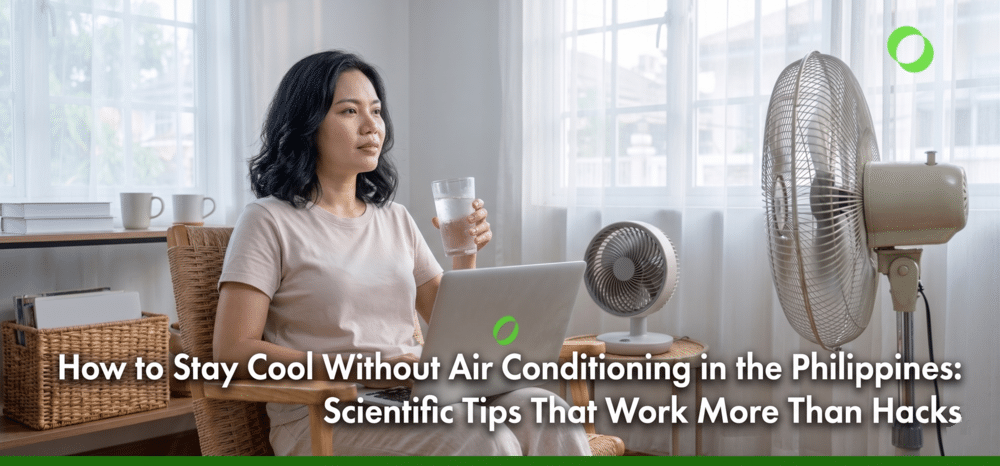
How do I stay cool without using AC? (How to stay cool in extremely hot weather?)
To stay cool in summer and extreme heat, reposition your fan to push hot air out instead of recycling it, block sunlight before it reaches the glass, and cool your pulse points, wrists, and neck with cold water when focus starts slipping. A basin of cool water under your desk keeps core temperature down for hours and helps you cool down without air conditioning. Schedule your hardest work before 11 AM, before the heat peaks and cognitive performance drops with it.
Heat index: init na may sumpa. Weather forecast: para kang siomai na nakatira sa steamer.
You’ve lived in the Philippines your whole life. So you’re not surprised that summer heat in the island-nation averages around 30°C to 34°C (86 to 93.2 degrees Fahrenheit) during the warm season. 42°C to 46°C (107 to 114 degrees Fahrenheit) on peak hot and dry days. High humidity? Yes.
That’s every Filipino’s reality, especially if you work from home. Do you open the windows? Or doors and windows at the same time?
As you soul-search whether to turn the AC on or leave it switched off a bit more, think about how to stay cool without air conditioning in the Philippines.
But before the 10 science-backed tips to cool your body and keep your home cooler without AC, you need to know exactly what you’re up against, because most guides skip this part entirely.
In This Blog:
One WFH Room With a Triple Heat Stack: Where Is The Heat Really Coming From?
There are three compounding heat sources unique to a work-from-home setup that few rise-and-repeat guides address. How to stay cool without AC Philippines? You’re looking at, or shall we say, feeling the burn from the following:
- Outdoor heat – Heat index levels climbing to 48°C in 2026; dozens of areas are entering PAGASA’s danger zone
- Device heat – a laptop running 6 to 8 hours radiates heat directly into the surrounding workspace
- Body heat – in a small, poorly ventilated room, your own heat has nowhere to go; it’ll cling on to you for dear life, from head to toe
These are why an open window and a fan or two alone don’t offer that much of a respite of cooler air, against the Philippine heat wave.
A standard laptop running at full load generates between 45 to 95 watts of heat output, similar to leaving an incandescent light bulb on directly at your desk, for eight hours straight (Anker).
Throw in extreme warm weather, and with the human body at rest produces approximately 80 watts of heat per hour (in a sealed 10 square meter room with little airflow), heat has nowhere to go but back to you.
Take a look at what you can do about it.
10 WFH Tips To Keep Cool Against Extreme Heat: How to Beat the Heat
#1. Run the Two-Fan Cross-Breeze Setup
What’s the difference between moving hot air and actually removing it? A single fan pointed at you is recycling the same overheated air already trapped in your room. It creates the sensation of breeze, but your ambient temperature doesn’t drop. For genuinely intense Philippine heat, that’s not enough.
Box fan? Standing fan? Ceiling fan? Whichever pushes heat better. The two-fan setup works differently to help cool your room from a lot of heat: position one fan facing outward near an open window or door to push hot air out of the room. Then place a second fan facing inward at another opening (a window on the opposite wall, a second door, or even a gap behind you) to draw in fresh, cool air. This directs airflow from both fans across the room, cooling the air quickly, while circulating it throughout so all areas benefit evenly.
More than comfort, this is “air exchange” and “air circulation” versus “air recycling.” One does nothing for temperature. The other actually clears the heat out of the room.
What To Do: Position Fan 1 facing outward at your room’s primary open window or door. Position Fan 2 facing inward at the opposite opening. Even a doorway or adjacent window works. For maximum effect, put the outward-facing fan as high off the ground as possible, since hot air rises and concentrates near the ceiling. In a single-window room, open the door to another space and use that as the intake side.
#2. Hose Down Your Exterior Walls Before Your Work Block
Why are your walls making your room hotter than the outdoors? Concrete and hollow-block walls (the standard in most Philippine homes) absorb solar radiation all morning and then radiate that stored heat inward throughout the afternoon. By 1 PM, your walls are functioning like slow-release heating panels. This is what drives the sensation that your room is still unbearably hot even after sunset.
Spray water on your exterior walls and on the side of the house that’s hit by direct sunlight the most. This temporarily lowers their surface temperature through evaporative cooling, and in effect, can reduce heat indoors. The water absorbs the wall’s stored surface heat and carries it away as it evaporates. Under water spray, the building surface becomes wetted, enabling direct heat exchange with the surrounding air.
Subsequently, driven by solar radiation, wind, and temperature, the retained water evaporates, carrying away latent heat and reducing surface temperature.
It won’t replace AC, but as a pre-work ritual before a deep focus block, it buys your room 20 to 30 minutes of measurably cooler walls, which means less heat radiating inward onto you.
What To Do: Before your most demanding work window, ideally between 9 AM and 10:30 AM, before the heat peaks, hose down the exterior of your sun-facing walls. Focus on the wall most directly hit by the morning sun.
For how to stay cool without AC Philippines, do this while windows are still open so you can catch the brief temperature dip. Prioritize your west-facing wall in the late afternoon for a second application.
Bonus Read: here’s a full guide to applying for a PAG-IBIG housing loan. Detour lang ng very light. You’re already thinking about how to make your workspace work for you in warm weather. Might as well get serious about building something that’ll last. Something you deserve for all your hard work.
#3. Keep a Stash of Frozen Towels on Rotation
What do medical teams use to cool down athletes experiencing exertional heat stroke on the field?
Ice-water soaked towels, rotated continuously to the head, trunk, and neck. Research on exertional heat stroke treatment confirms that rotating ice water-soaked towels can be deployed quickly, require minimal equipment, and provide a measurable cooling rate, making them one of the most practical field-cooling methods available.
It also helps with regulating core temperature and providing immediate relief from heat-related discomfort. For maximum cooling, apply to areas where blood vessels are close to the skin surface, such as the neck, wrists, or forehead.
For a WFH setup, the freezer does the heavy lifting. You pre-cool the towels while you work, then pull them out in rotation. Once every 30 to 45 minutes during peak heat hours.
What To Do: Dampen five to six small face towels and fold them into your freezer the night before or early morning. Pull one cold, wet towel out every 30 to 45 minutes during your 11 AM to 3 PM peak heat window. Apply to the back of your neck, forehead, and wrists, not just draped loosely, but held in contact with the skin for 30 to 60 seconds.
Return the used towel to the freezer, bring out the next one. The rotation keeps the cooling effect continuous across your entire work block.
#4. Block the Sun Before It Gets Inside
Once sunlight passes through glass, heat tags along immediately. This is because sunlight travels as infrared radiation: invisible heat waves that pass right through glass, the same way visible light from the summer sun does. No air flow.
Your window blocks wind and rain, but to keep your house cool without air conditioning? It has no defense against the heat the sun carries.
Blackout curtains and blinds to cool your home? Not so much. They’re great for slowing the heat from bearing down on and through your windows. But they can’t do anything about the heat that’s already entered.
Block externally instead, with something positioned before the glass. It’s actually an energy-efficient cooling principle taken from Filipino tropical architecture: external shading, a.k.a. passive cooling design.
What To Do: Do the external option first by placing bamboo or woven blinds outside your window frame or in front of sun-facing windows. Awnings and tall plants work too. Then hang blackout curtains on the afternoon sun-facing windows, keeping them closed from 10 AM to 4 PM.
Identify your “west-facing” wall and prioritize this part of your work-from-home space.
#5. The 30-Second Reset: Cool Your Wrists and Neck
Your body has pulse points, spots where blood vessels lie close enough to the skin’s surface that cooling them actually cools your circulating blood. Your wrists, the back of your neck, behind your knees, and your inner elbows.
When you run cold water over your wrists for 30 seconds, you’re cooling the blood passing through the radial artery. That cooled blood recirculates through your whole body.
“
The American Red Cross and thermal physiology research confirm that 30 seconds of cold water on the wrists produces a measurable drop in core body temperature.
Thermal Physiology Research
What To Do: Pause your work timer and run both wrists under cold tap water for 30 seconds when your focus starts melting due to the heat. Or keep a small face towel in the freezer and press it to the back of your neck before or during a long work session. The process takes 30 seconds or less.
While you’re at it, here are Simple Steps to Getting a TIN ID. Just like how making your WFH area more comfortable to work in is important, so is having a TIN ID.
#6. Sweat It Out Before Your Work Block
Here’s the counterintuitive one: want to feel cooler sitting at your desk? Make yourself sweat first.
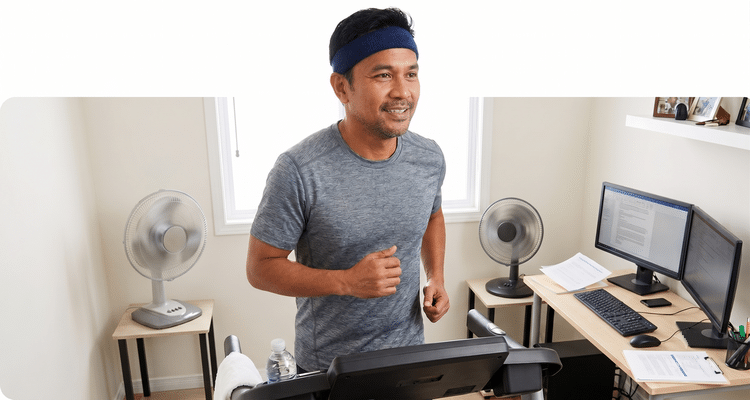 Intense exercise before a work session forces your body’s thermoregulatory system into overdrive. Sweating is the body’s principal means of preventing excessive increases in core temperature.
Critically, it is the evaporation of sweat, not the sweating itself, that facilitates actual heat loss: when sweat evaporates from the skin, it draws heat away from the body, reducing core temperature.
A full sweat session followed by a cool shower produces a pronounced and lasting drop in core body temperature. The kind that makes sitting at a desk feel manageable even without AC.
Regular aerobic exercise also produces heat acclimatization: an increase in sweating capacity, a more dilute sweat, and an enhanced ability to sustain high sweat rates. All of which keep the heat at bay over time and reduce the risk of heat-related illness and heat exhaustion.
What To Do: Schedule 20 to 30 minutes of intense exercise. Do jumping jacks, bodyweight circuits, a fast walk, or jog outdoors before your deep work window. Aim to break a full, dripping sweat. Immediately follow with a cool shower and air-dry (don’t towel off arms and neck: see tip #7 below).
Have a water bottle within reach and rehydrate with at least 500ml of water. Sit down at your desk within 10 minutes of stepping out of the shower to catch the cooling window at its peak.
#7. Shower Before Your Deep Work Window and Skip the Towel
Cold showers drop core body temperature quickly. When cold water hits your skin, your blood vessels near the surface constrict, a response called vasoconstriction. The reaction temporarily pushes warm blood away from the skin and toward your core.
Your core then redistributes that blood, and as it circulates back outward, it loses heat through the skin faster than it normally would in static, warm air. As a result, your core body temperature drops measurably.
“
It’s been a long-standing myth that cold showers produce only skin-deep coolness. The sudden shock can actually cause blood vessels near the skin to constrict, trapping heat deeper in the body instead of releasing it efficiently.
Thermal Physiology & Vasoconstriction Myth
Air-drying instead of towel-drying extends the cooling effect through evaporation for up to 15–20 minutes after stepping out. It’s the same mechanism as sweating. Most guides say “take a cold shower” without explaining this next, just-as-important part.
What To Do: Time the shower right before the most demanding work window — before 9 AM or around 2 PM is recommended, before an afternoon focus block. After stepping out, do not towel-dry arms, neck, and legs. Stand in front of a fan for 3–5 minutes. The extended cooling effect from the air-dry phase is science-magic.
#8. Mist Yourself Every Hour
Now this is a viral trend you might’ve seen on socials, though this one has a different purpose. Misting or spraying water on your skin works in the manner sweating does: evaporation removes heat from the surface. Combine this with good fan airflow, and it lowers skin surface temperature.
Without airflow, it just makes you feel damp. Yale’s Hixon Center for Urban Sustainability calls this “self-dousing” and identifies it as one of the most effective personal cooling strategies that can be done just about anywhere.
What To Do: Fill a small spray bottle with cool water. Set it on your desk, and make it a part of your work-from-home tools. Mist arms, neck, and face lightly every 45 to 60 minutes, then let the fan airflow do the rest.
Optional upgrade: Store two or three more spray bottles in the fridge and replace the one on your desk whenever the mist is no longer cool.
#9. Switch Off Everything You’re Not Using Right Now
That means all electronic devices apart from the laptop or desktop you’re using for work. Every plugged-in gadget and appliance generates heat, even when they’re on standby. In a small room where you spend consecutive hours, that turns into background heat that builds up.
The combined heat from a laptop, monitor, and charger, not to mention additional light sources and home appliances, adds several degrees to ambient temperature.
This is the device heat layer of the triple heat stack. And it’s the layer you have complete control over.
What To Do: Unplug chargers when nothing is charging. Close background tabs and unused apps. A hard-working laptop runs hotter than one working with only what’s open.
#10. Heat-Block Your Calendar
Thanks to weather forecasting and real-time updates, you can track the times within a day when the heat is most aggressive in your area. Philippine heat peaks at 11 AM to 3 PM, the same window when your remote workspace has been accumulating heat since morning, and when cognitive decline from sustained heat exposure is at its worst.
Schedule flexibility is one of the real privileges of being in a remote work setup. WFH employees fail to use it strategically and consistently around temperature. Open windows early morning, when the heat isn’t yet at its most brutal. 5 AM to 8 or 9 AM is ideal. Allow the trapped, warm air from the night before to be replaced by cool, natural ventilation.
What To Do: “Heat-block” your schedule and mark your work zones: simple task zone, heavy task zone, meeting zone, emails and calls zone. Prioritize your hardest to-dos in the low-heat windows. If they fall inside the 11 AM to 3 PM danger window, apply the applicable tips above.
Bonus Read: While you cool your workspace (and headspace), here’s a take on The Middle Class Squeeze and how to make dollars online in the Philippines, in spite of skipped ayudas and rising fuel costs.
You’ve Cracked the Heat Code. Now Crack the Remote Work Market.
How to stay cool when you have no AC in the Philippines? Surviving the heat is a small sliver of the remote work equation. Don’t let it hijack your workflow. Working offshore is about being present, reliable, and independent yet collaborative every single day. Ready for growth and ready to deliver work that measures up globally. No matter the weather.
That’s what we look for when vetting Filipino candidates and matching them with American and Australian business owners. Filipino remote workers already bring a lot to the table. Strong English, a reputation for being easy to work with, and a work ethic that international clients keep coming back for.
A home setup that works with you is what turns all that into a career that lasts. One that keeps you cool under pressure, and summer heat waves out.
Remote Staff has been making those matches for over 18 years. Browse the current openings and see what fits.
Since you’re on your journey to finding the right role, here’s a Complete Guide to Voluntary Contributions (SSS, PhilHealth, and PAG-IBIG).
FAQs
Does opening windows make a room cooler without ac?
Not always. Opening windows during peak afternoon heat in the Philippines can sometimes pull hotter outdoor air indoors and raise the indoor temperature further. For work-from-home setups, open windows early in the morning or later in the evening when outdoor air is cooler, and pair them with directional airflow so heat exits instead of circulating inside the room.
Why does working from home feel hotter than working in an office?
A home workspace concentrates heat differently. Unlike commercial offices with centralized cooling and larger air volume, a small room traps heat from the outdoors, electronics, and your own body over long work blocks. That combination can make remote work feel warmer and more mentally draining, even when the temperature reading looks similar.
Can heat affect productivity and focus when working remotely?
Yes. Heat does more than create discomfort. As body temperature rises, concentration, reaction speed, and mental endurance can drop, making routine tasks feel heavier than usual. Structuring your day around cooler hours and reducing heat buildup in your workspace can help protect focus without relying entirely on air conditioning.
Is Remote Staff PH legit?
Yes. Be sure you’re going to the correct URL. Remote Staff PH has been pairing Filipino remote workers with Australian and American clients for over 18 years. We never charge for application or onboarding. Any agency using our name and claiming you need to pay upfront is most definitely a scam.
How much is the salary in Remote Staff PH?
Salary at Remote Staff PH depends on the role, experience level, client requirements, working hours, and specialization. There’s no single fixed pay range: compensation is matched per role and is generally negotiable. Entry-level support roles, creative work, operations, sales, and specialized technical positions can differ significantly in monthly pay, so the best benchmark is the salary listed on the active job posting you’re applying for. Check these details per job posting.
Related Read: Already a VA and thinking of upskilling? Or you’re new to WFH? Here’s How to Become a Technical Virtual Assistant.
Heat-Proof Your WFH Space and Heat Up Your Client Search
Philippine heat is predictable. Same low-heat hours and that brutal 11 am to 3 pm window during the hottest leg of the day. Once you change your mindset around it as something you shouldn’t merely endure but work around, the weather stops becoming a hindrance.
Work becomes less affected despite “init na parang pinaparusahan ka personally,” when you apply these tips.
The best Filipino remote workers don’t have to rely on AC all the time to stay cool indoors. Like what this blog says, no AC, no problem. You don’t have to worry about electric bills shooting up by extension. Focus on these passive cooling methods while building your portfolio and remote career. “Yung araw galit? Mas galit ako.” Better yet, work mode muna, zoned in.
Pick two tips from these home cooling tips without AC and try them tomorrow. Keep adding one or more when the summer heat index moves towards extreme.
Ready to beat the heat, cool a room without AC, and find the right client? Contact Remote Staff today.
Get inspired by BINI’s journey in BINI Coachella 2026 and learn why the Filipino workforce is a “force” to be reckoned with in the global remote space.